
WS Form allows you to lock forms in WordPress to prevent accidental edits to fields, settings, conditional logic, and other form configuration. Form locking is particularly useful for published forms that are actively collecting submissions and should not be modified without authorization.
Only users with the necessary WordPress capabilities can lock or unlock forms. When a form is locked, it cannot be edited, unpublished, or moved to the trash until it has been unlocked by an authorized user. The form continues to work normally on your website, including accepting and processing submissions.
How to Lock a Form in WordPress
To lock a form:
- Navigate to WS Form in the WordPress administration menu.
- Locate the form you want to lock in the All view.
- Click the open padlock icon in the Status column.
- Click Lock in the confirmation dialog.
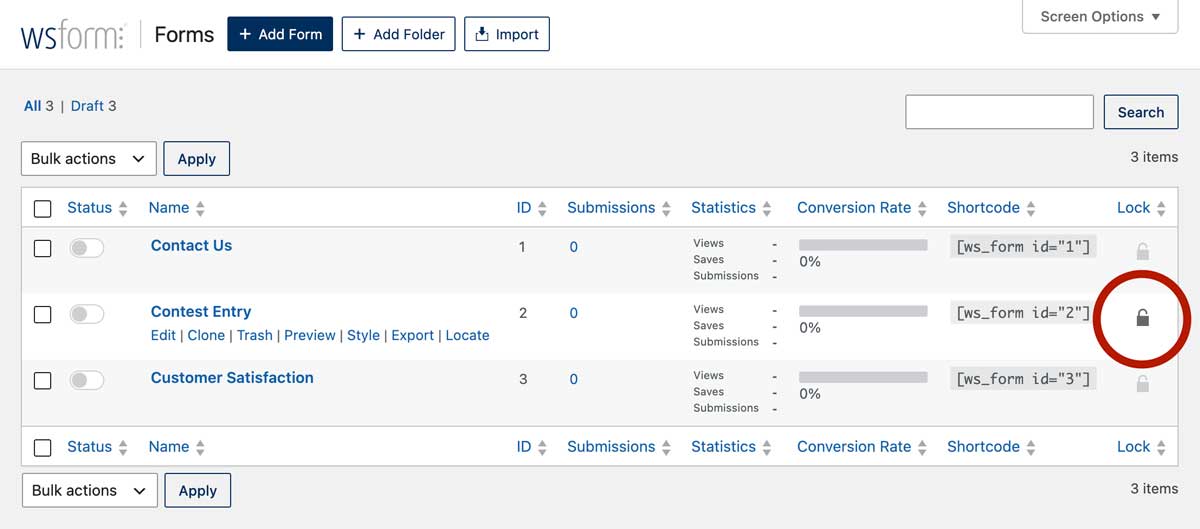
Once locked, the padlock icon changes to a closed blue padlock. The publish switch is disabled and the option to move the form to the trash is removed.

What Does Locking a Form Do?
Locking a form protects its configuration from accidental or unauthorized changes without affecting how the form operates on your website.
When a form is locked, the following actions are prevented:
- Editing form fields, sections, and layout.
- Changing form settings, actions, or conditional logic.
- Publishing or unpublishing the form.
- Moving the form to the trash.
Locking a form does not disable it. The following actions remain available:
- Visitors can continue submitting the form.
- Form submissions can still be viewed and managed.
- The form can still be previewed.
- The form can still be exported.
- The form can still be located on your website.
- The form can still be cloned. Cloned forms are unlocked by default.
Note: Form locking does not prevent changes to form styles. Form styling is managed independently of the form lock.
What Happens When You Try to Edit a Locked Form?
When you attempt to edit a locked form in WS Form, the layout editor is replaced with a locked form screen. This prevents changes to the form until it has been unlocked.
The screen displays a message indicating that the form is locked, together with an Unlock button if your WordPress user account has permission to unlock forms.
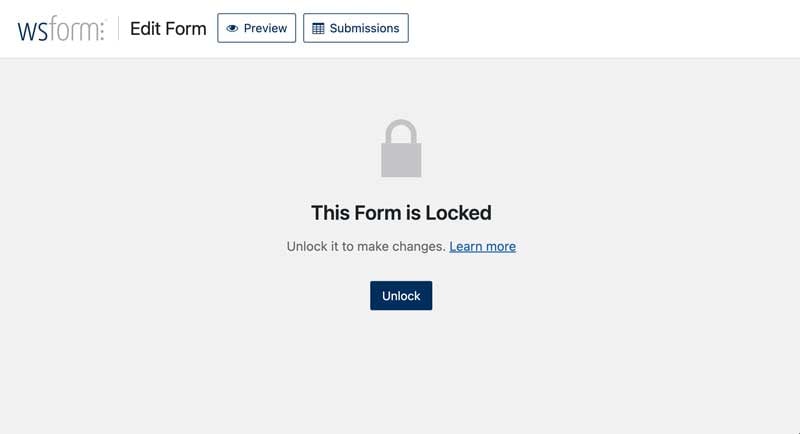
You can still access Preview and Submissions without unlocking the form.
How to Unlock a Form in WordPress
To edit a locked form, you must first unlock it. WS Form provides two ways to unlock a form.
Unlock from the Forms List
- Navigate to WS Form in the WordPress administration menu.
- Locate the locked form.
- Click the closed padlock icon in the Status column.
- Click Unlock to confirm.
Unlock from the Locked Form Screen
- Click the name of the locked form or its Edit link.
- Click Unlock on the locked form screen.
- Click Unlock in the confirmation dialog.
Once unlocked, the form can be edited, its publish status can be changed, and it can be moved to the trash.
How to Lock or Unlock Multiple Forms
WS Form supports bulk locking and unlocking, allowing you to protect multiple forms in WordPress without updating each form individually.
To lock or unlock multiple forms:
- Navigate to WS Form in the WordPress administration menu.
- Select the checkboxes next to the forms you want to lock or unlock.
- Select Lock or Unlock from the Bulk Actions dropdown.
- Click Apply.
Bulk locking and unlocking options are not available in the trash view.
Who Can Lock and Unlock Forms?
WS Form uses WordPress user capabilities to control who can lock and unlock forms. By default, administrators have permission to perform both actions.
The following capabilities control access to form locking:
lock_formAllows a user to lock forms.unlock_formAllows a user to unlock forms.
These capabilities can be assigned to other WordPress user roles when you want to allow specific users to manage form locks.
If a user does not have permission to lock forms, the open padlock icon is hidden. If a user can view a locked form but does not have permission to unlock it, the closed padlock icon is displayed but cannot be clicked.